
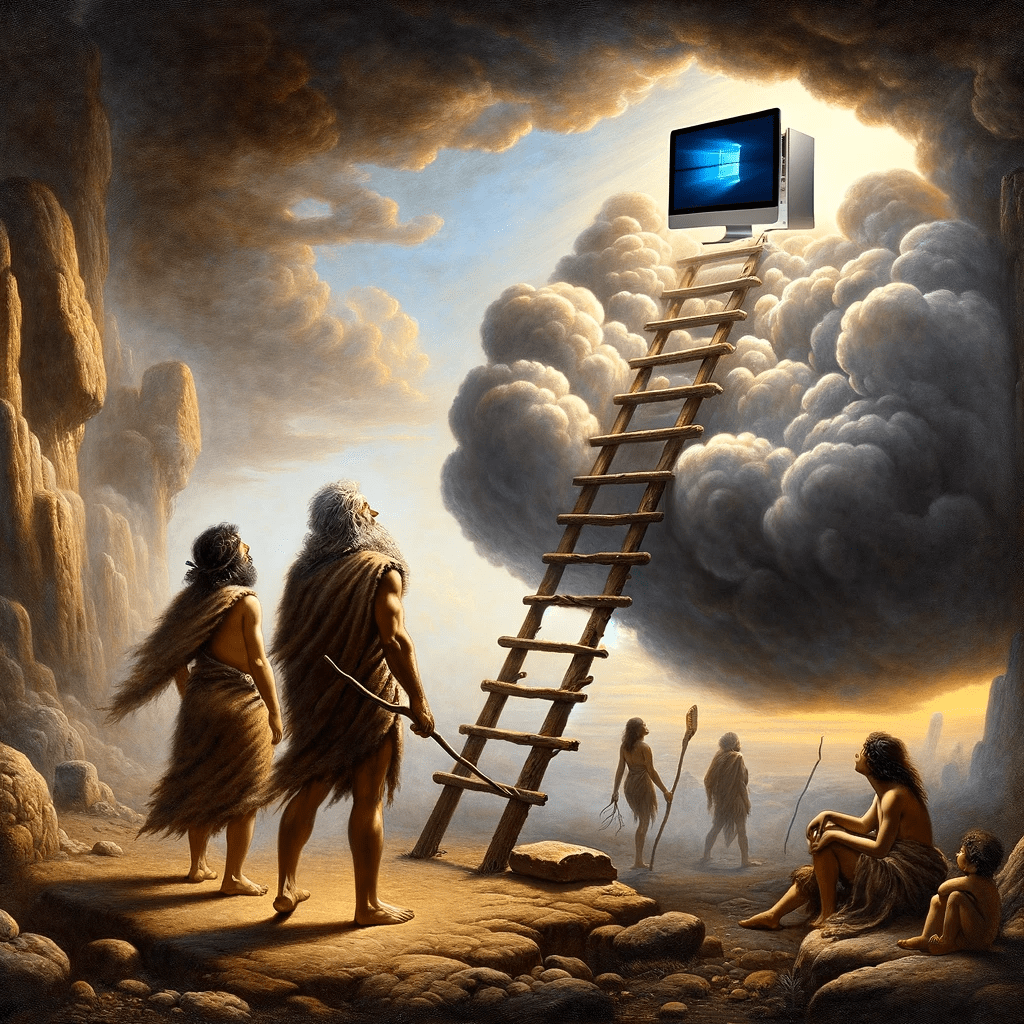
The aim of this article is to elucidate the anthropological conditions of possibility for computing. I will first show how symbolic manipulation is constitutive of hominization. Secondly, I will examine the gradual widening of the gearing between the sensorial world (signifiers) and the intelligible world (concepts) during cultural evolution. Following on from these analyses, I’ll comment some of the main features of contemporary digital civilization, including the development of generative artificial intelligence.
Phenomenal experience
In the animal kingdom, the development of the nervous system stems from the need for locomotion: the senses and motor skills are looped together to guide movement. Over the course of evolution, this reflex circuit becomes more complex, involving simulation of the environment, evaluation of the situation and decision-making calculations leading to action. An existential emergence accompanies cognitive necessity, as the nervous system generates a phenomenal experience populated by multimodal images (cenesthesia, touch, taste, smell, hearing, sight), including the sensation of one’s own movements. Animal consciousness relates to a world outside itself: it is intentional. Its objects are conserved beyond the variety of immediate perceptions. Pleasure and pain polarize the range of sensations, and emotions direct activity. Locomotion obliges the animal to localize its presence and inhabit a territory. Its consciousness is not only immersed in space and full of present sensations, but also virtualized by an imagination that reminds it of past events (the squirrel remembers the places where it hid its nuts), ensures the continuity of its movements and projects it into the immediate future. It discerns the situations in which it is thrown and categorizes the objects of its perception. It recognizes prey, predators or sexual partners and acts accordingly. This is only possible because neural circuits (innate or learned) encode interaction patterns – or concepts – that orient, coordinate and give meaning to its phenomenal experience, while supporting complex social communication with its fellow creatures. Animal communication signals – calls, postures, pheromones – carry concepts (« predator approaching », « food », « this is my territory », « submission », etc.) but they are biologically inherited, limited in number and complexity, and refer only to current situations.
The symbolic revolution
Upright posture, the hand, toolmaking, and the mastery of fire set the Homo genus apart. Then Neanderthals, Denisovans and Sapiens start talking. Our brains have the same properties as those of higher vertebrates, with the cognitive and communicative capacities just mentioned, and the corresponding type of sensorial experience. But it also possesses a capacity for recognizing and producing symbols that takes us into a whole new world. The biological evolution that leads to the human being has transformed the brain of the initial primate, adjusting it to a symbolic specialization that is unique in the animal kingdom: hypertrophy of the prefrontal cortex, amplification of the cerebellum, appearance of Broca’s and Wernicke’s areas, greater division of labor between the hemispheres and general reorganization of neural circuits. As an ontological interface, the human brain drives the symbiosis and coevolution of symbolic ecosystems with populations of speaking primates immersed in the biosphere.
What is a symbol? In a nutshell, it’s the conventional translation (which varies from society to society) of a concept – i.e. a scheme organizing the experience – into a sensory phenomenon. It should be added that – far from being independent of one another – symbols are organized into systems that regulate their compositions, substitutions and differences. By projecting themselves onto the sensorial images of symbolic systems, the concepts that organized the phenomenal world from the opaque interior of the vertebrate cranium become explicit, sharable and combinable at will. The symbolic revolution has repercussions for the lived world as a whole. Communication is cast in the mold of conventional languages and codes; complex rituals organize social relations and combinations of artifacts drive sensorimotor interactions.
Communication
In contrast to the indexical or iconic communication of other animals, we tell what happened yesterday, make appointments for next week and invent stories. The territories of our evolutionary ancestors were populated by actual objects and agents. The human world is also made up of places, beings and events that are invisible, or have long since disappeared, or will never happen. A language has thousands of elementary units of meaning, orders of magnitude more than the signal repertoire of animal species. Verbs and common nouns designate general categories, while proper nouns label singular beings and events. Language translates interaction patterns into sentences. The verb evokes the action, grammatical roles describe the actors and circumstances, and the whole models a complex scene. Each word in a sentence also evokes a pattern of interaction: « gift », « sacrifice », « birth », « hunt » and so on. Linguistic symbols are organized according to a recursive grammar: expressions are composed in sequences and fit together like Russian dolls, making it possible to construct and decipher an indefinite number of complex texts with distinct meanings. Talking primates elaborate the schemas that organize their experience with hyper-realistic detail. The immediate and massive concepts of other animals give way to genealogies, fine classifications, genera, species and their differences, webs of refined notions whose every node is in turn a network. Our narratives interweave and respond to each other. The range of mental representations expands indefinitely.
The linguistic symbol is split in two, since it has (a) an actual or signifying part: a sound, visual, tactile or other image, such as the sound « tree », and (b) a virtual or signified part: a general concept, such as « woody plant with roots, trunk and branches ». The signifier itself is split into an abstract form (phoneme, character, gesture) without address, timeless, and some concrete, situated, dated image: this timbre of voice, this letter, a waving hand. The signified, in turn, has both a virtual and an actual component. The dictionary and grammar of a language define the virtual, general, still-floating part of the meaning of a word. Our knowledge of language enables us to decode this sequence of phonemes and translate it into a network of concepts, a narrative that evokes images, emotions and memories. For a moment, a rhizome of meaning illuminates the silence of experience. A meaning is actualized in this way for us, but it would be actualized differently in other circumstances for someone else, endowed with a singular memory.
Although the signifying parts of symbols – moving images – only appear to the senses in phenomenal space-time, for human intelligence they designate signified that populate an inexhaustible abstract universe, at the intersection of hierarchical structures of composition (syntagms) and symmetrical structures of opposition and substitution (paradigms). Such arrangements – both syntactic and semantic – are not limited to languages. They can be found to a greater or lesser extent in other sign systems. For example, like the paradigms of language, the harmonies of music organize an order of simultaneity and possible choices, while melody unfolds linearly in time, like the syntagm in linguistics. As for visual communication, palettes of shapes and colors form substitution groups that intersect the compositional plane of images.
Elementary emotions are diffracted into a myriad of mingled feelings, violent or delicate. Places are named, measured and mapped. The dense net of hours and calendars captures temporality. Language opens the space for questioning, dialogue, and narrative. It supports reasoning, demonstration and a concern for truth… not forgetting misleading concealment and disinformation. What’s more, it’s not only messages that are coded, but also systems of veridiction, i.e., depending on the occasion, ways of deciding what is true or beautiful.
Society
The person and its individual identity emerge through dialogue. The implicit self-reference in animal experience is redoubled in humans by an explicit first person (“I”), to which a second person – the other – inevitably faces and responds (“You”). Both navigate the shared reality perceived in the third person (“It, them”), a world assumed to be objective and common.
Societies of the same animal species resemble each other. In contrast, human groups know a great diversity of social roles and rules of interaction. Kinship, political organization, or commerce with the invisible (ancestors, spirits, gods, and values) fall under convention. Rituals codify, socialize, and reify a symbolic order that systems of justification – morals, laws, religions, traditions – explain and motivate.
Social roles have common traits with grammatical roles, not the least of which is recursive nesting. The syntactic trees of language correspond to the genealogical trees of families and the organizational charts of administrations. Oppositions of the type « brother and sister » in the role of full sibling or « police and army » in the role of security guarantor, or even the social partitions of the type « priests, warriors, and peasants » resemble the groups of difference and substitution of lexical paradigms.
Technique
If symbolization consists in projecting into the world of senses and systematizing behavior patterns, then it concerns not only communication codes and social relations but also interactions with the physical world. Artifacts and tools are produced by common methods, they exhibit « affordances » (possibilities of use) and dictate gestures. The most material techniques participate in the symbolic order through their externalization and socialization of bodily functions, through their reification of perceptions and movements. A fortiori, the virtual dimension of our relations to things composes an essential part of cultural systems: the rules that govern labor and property, the processes of exchange and accounting. While animal societies know neither currency nor economy, the most primitive tribes use shells for their bartering and keep memory of gifts and counter-gifts.
Syntax finds its place in the battle order of armies and the arrangement of technical gestures. The arborescent structures of sentences and texts are found in the sequence of operations leading to the construction of buildings, the weaving of fabrics, or the cooking recipes. And in most cases, Homo Faber can replace one material with another, alter the thickness of threads, or substitute potato for rice while retaining the general action plan. The same wooden handle ends in the metal head of a shovel, a pickaxe, or a fork, just as the words of a paradigm may substitute for one another in the same narrative context.
Cultural symbiosis
The orders of signs, people and things are intertwined in the tight braid of hominization. We have only examined them in turn for the sake of exposition. Let’s define culture as the totality of symbolic systems (semiotic, social, technical), their products and their layers of sedimented inscriptions. From then on, the life of the mind – which transcends individual existences – results from a symbiosis between the speaking primates that make up a society and the culture they share.
Cultures codify, share and reify concepts (the patterns organizing experience), while individuals incorporate languages, rituals and technical practices. The conventions and tools transmitted by culture can only be implemented if living people internalize their uses, embody their handling and treat them as second nature. This is why, however diverse – or even heterogeneous – social constructions and cultural artifices may be in a particular time and place, the living bodies that integrate them make an organic unit out of them.
It can take many years to learn how to handle semiotic conventions, as in the case of writing. For interlocutors to reconstitute networks of concepts from a sequence of phonemes and translate ideas or instructions into sounds, all the following needs to be integrated into the reflexes and perceptive habits of the organism: the dictionary that establishes the correspondence between signifiers and elementary signified, the grammar that governs the composition of units of meaning, not forgetting the prosody, accents and music of the language. The same applies to social relations. We learn to discern the interpersonal relationships at play in our environment, to identify with roles, to embody them as best we can, and to play our part in conventional scenarios, aided by initiation journeys and the repetition of ritual enactments. The use of artefacts, the handling of tools, the driving of vehicles and the collective execution of complex tasks once again presuppose the physical and mental internalization of ambient techniques.
Individuals can only survive if they assimilate symbolic systems and appropriate their products. Symmetrically, to endure, a culture must be absorbed, implemented, and transmitted by individuals. In this relationship, where each participant feeds off the other, culture represents the virtual pole, neither dead nor alive, waiting to be actualized by a human population. As for individuals, they embody the subjective, present, sensitive, living and mortal pole of the symbolic dynamic. And each generation, whether oblivious or ardent, innovative or decadent, casts the dice again. Such is the motor of cultural evolution. The immemorial heritage of our ancestors sustains our living spirits, just as from the depths of tropical waters the coral piled up by centuries carries multicolored fish towards the sunlight.
Symbolic stigmergy
The collective intelligence of animals is largely based on stigmergic communication: the traces they leave in a shared environment enable them to coordinate their actions. The scent of pheromones, the echo of cries and songs, the fleeting image of postures or footprints elicit immediate reactions. Like other eusocial species, we communicate stigmergically, but instead of marking a physical territory with pheromones or other types of visual, auditory or olfactory signals, we leave symbolic traces. The human kingdom amplifies stigmergic mechanisms. Elaborate symbolic texts accumulate, respond to each other, they are fed and reappropriated by groups and individuals. Not only does the shared memory become longer and more complex, but the synchronization of experiences and the propagation of affects intensifies. Now that symbolic systems have been incorporated by individuals, signifiers, ritual gestures and familiar artifacts automatically trigger neural circuits, along with the patterns of interaction, emotions, images, memories and motor impulses they evoke. Just as contact with a pheromone molecule triggers reflex behavior in an ant, we can’t help but understand speech that reaches our eardrums, and the slightest story irresistibly evokes mental representations and feelings. The audience at a show, the dancers at a rave, the demonstrators chanting a slogan all resonate. The members of a rowing or soccer team are perhaps more in tune than a herd of baboons or a clan of wolves will ever be.
Symbolic manipulation
Let it be clear that the human mind never leaves sensory experience. The most complex combinations of culture are rooted in a spatio-temporal universe, inhabited by tangible objects and agents, interwoven with imagined causal relations, animated from within by the tropisms of emotion, resonating with timbres and rhythms, alternating shadow and light, sweetness and violence. But this sensory experience, because it is significant for our symbolic species, points to an intelligible world whose relationships, successions and connections are quite different from those of space, time and material causality. The concepts that populate the intelligible world can be located at the intersection of three axes. A first axis – closely symbolic – organizes the correspondence between sensory images and their conceptual counterparts, whether linguistic signifiers, social relations or technical functions. A second axis structures concepts according to syntactic trees, each leaf of which can become – recursively – a root. In the order of signs, grammars compose linguistic or musical phrases, assemble texts and images, and arrange artworks according to skillful taxonomies of periods, genres, schools and subjects. Social syntaxes shape the structure of institutions, hierarchizing or symmetrizing ages, genders and classes; they regulate games, distribute roles, balance powers and divide labor. Technical syntaxes schematize operations in series or in parallel, lay out small workshops and vast factories, interweave machine parts and logistics chains. Finally, the third axis – paradigmatic – orders the systems of differences and substitutions whose rotating rings fill the nodes of syntactic trees. The intelligible world unfolds between these three axes, teeming, diverse, interdependent, mutating, hybridizing, swept along by an irreversible cultural evolution.
In short, symbolization places the human mind at the interface between two worlds: that of physical movement and sensory images, governed by a group of spatio-temporal transformations, and that of intelligible forms, governed by a group of conceptual transformations. This is why ideal operations are linked to physical operations and, symmetrically, tangible transformations lead to conceptual changes. The morphism that links the two universes opens a field of action inaccessible to pre-symbolic animality, since it becomes possible to command conceptual transformations from physical movements and to sequence material gestures according to conceptual operations. At the core of anthropogenesis, we discover symbolic manipulation. Calculation is original. From the folding of the conceptual onto the perceptual, and its condition of possibility in the human brain, the widening of the passage between the two orders of reality, and the growing efficiency of their reciprocal translation, set the pace for a cultural evolution that never ceases to take up and amplify the event of hominization.
Implemented in a distributed manner in the brains of speaking primate populations, five symbolic operating systems have succeeded one another, each new version being fully compatible with the previous ones. Nomadism, tribal organization, hunting and gathering, knowledge transmitted through rituals and storytelling, and shamanism for relationships with the invisible correspond to primary orality. The first writings, or the self-preservation of symbols, accompany palace-temple civilizations, large-scale breeding and agriculture, the school of scribes and the systematization of knowledge. The zero, the alphabet and paper optimized the manipulation of signifiers in trading cities and empires, with their literate elites, universal religions, philosophies and currencies. From the 16th century onwards, the mechanization of writing and time measurement heralded modernity: the natural sciences became experimental and mathematical; engines revolutionized industry and transport; nation states, new secular perspectives on salvation (such as liberalism or socialism) and compulsory education transformed societies. Finally, the electrification, electronic media and computerization of the twentieth century pave the way for contemporary digital culture, based on techniques for controlling energy and matter on the scale of elementary particles, the automatic transformation of signs, instantaneous interactive global communication and the information economy. It is still difficult to specify the new political, epistemic and ideological forms that will prevail in the new culture. What is certain, however, is that the digital is our global symbolic operating system, not only – as is obvious – in terms of communication and technology, but also in terms of social relations.
Is this a return to the fable of progress (« It just gets better and better »)? No, because an operating system can support a variety of applications, which can be judged as good or bad depending on one’s point of view. The same « nation-state » political form has a liberal and a totalitarian face, the same industrial structure manufactures cars and tanks, the same Internet serves information and disinformation. I would add that the general notion of progress assumes a constant evaluation criterion from the Paleolithic to the 21st century – this criterion generally being that of contemporaries – while each era, each culture reinvents its ultimate values.
My partition into five successive symbolic operating systems simplifies a continuous process, unevenly distributed in space, subject to multiple shifts, backtracking and leapfrogging. What’s more, the cultural forms that appear in each era do not disappear in subsequent eras but are taken up again and adapted to a new context. Despite the complexity of the process, the general evolution seems irreversible and firmly oriented towards an ever more efficient interplay between the world of senses and the intelligible.
Digitizing communication
In the long run of accelerating evolution, symbols detach themselves from their places of origin, surviving better and better the moment of their birth. Here they are, becoming lighter, more numerous, more widespread, translated and transformed. But the « softer » the symbols become, the more they approach an omnipresent, malleable form that escapes the inertia of matter, the more their inscription requires « hard » supports, instruments and installations that are heavily material. The manipulation of signs has a long history, in which the virtualization of codes and the hardening of media are mutually supportive: clay tablets, papyrus or silk scrolls, the road and port networks of ancient empires, horse-drawn mail, paper manufacture, printing machines, school and library buildings, telegraph poles on railroad lines, antennas and satellites, right up to data centers that consume the electricity of a power plant and the magazines, radios, record players, televisions, computers and telephones spewed out by factories and eventually piled up jumbled in waste dumps.
The intelligible and the tangible alternate, intertwining and complicating each other. Each turn of their evolving spiral deposits a new layer of complexity, which leads to the next revolution. These two modes of being are like the relationship between Yin and Yang in traditional Chinese philosophy. One of the main Confucian classics, the Yi-King (or I-Ching) represents the dynamics of cosmic, political, and personal transformations by means of sixty-four hexagrams: six stacked lines, some of which are continuous (Yang), and others broken (Yin). This ancient oracular book presents one of the first alignments between the signifying structure and the signified situation: the two planes of the hexagrams (signifiers) and the practical configurations (signifieds) obey the same group of transformations. Should we trace back to this the binary coding and the regulated manipulation of signifieds by means of signifiers that characterizes computing? Or should we identify the beginnings of automatic calculation with Aristotle’s formalization of logical reasoning? What about the Indian mathematicians who invented positional numeration with nine digits and the zero, making arithmetic calculations simple and uniform? Or the development of algebra by Arabic-speaking, Andalusian or Persian mathematicians, such as Al Khawarizmi, who gave his name to the algorithm? In all these cases, the regulated, quasi-mechanical manipulation of visible, tangible elements leads to the movement of virtual objects: political tropes, logical propositions or insubstantial numbers.
Calculation
Let’s take a closer look at calculus, a textbook case of the clutch between the sensible and the intelligible. It can be defined as the art of mechanizing symbolic operations. Calculus presupposes the adoption of a coding system for variables and operations, as well as the definition of chains of operations: algorithms. The application of an algorithm to a set of input variables leads to the result variable as output. As symbols are made up of a signifier and a signified part, calculations are even more efficient as they are applied to signifiers in a mechanical way, i.e. without taking signifieds into account. Algorithms are blind to the semantic content of the symbols they manipulate. Even when we multiply by hand, we always follow the same routine, whatever the numbers being multiplied. The signifiers manipulated by operations can be likened to material pieces such as tokens, marbles or pebbles. The word calculus itself comes from the Latin calculus meaning pebble, because the ancient Romans used pebbles to perform arithmetic operations on abacuses.
Calculus is an art insofar as the coding of the signified by a certain system of signifiers facilitates the regulated manipulation of symbols to a greater or lesser extent. For example, the number notation system of the ancient Egyptians and Romans does not lend itself to as efficient algorithmic manipulation of numbers as the zero-based positional notation of the Indo-Arabic numerals. Try multiplying large numbers using Roman numerals to see for yourself. The efficiency of symbolic manipulation involves a compromise between, on the one hand, the generality of algorithms (maximizing the cases to which they apply) and, on the other, minimizing the number of operations required to arrive at the result. Calculus is an art insofar as the coding of the signified by a certain system of signifiers facilitates the regulated manipulation of symbols to a greater or lesser extent. For example, the number notation system of the ancient Egyptians or Romans does not lend itself to as efficient algorithmic manipulation of numbers as the zero-based positional notation of the Indo-Arabic numerals. Try multiplying large numbers using Roman numerals to see for yourself. The efficiency of symbolic manipulation involves a compromise between, on the one hand, the generality of algorithms (maximizing the cases to which they apply) and, on the other, minimizing the number of operations required to arrive at the result. Advances in algebraic coding and the refinement of automatic calculation procedures generally mark a leap in consistency and rigor in the field to which they apply, as shown by the breakthroughs of modern experimental science, which have often unified disparate forms and methods by means of algebraic sweeps.
Calculating machines
Mechanical calculating machines had already been built in the 17th century by Pascal and Leibniz. Babbage and Ada Lovelace built bigger computing machines in Victorian Britain. Cash registers were already performing arithmetic operations in every shop at the beginning of the 20th century. But to achieve programmable electronic calculators – much faster and more adaptable than earlier machines – several theoretical and technical advances had to be made first. On the theoretical side, as early as 1937, Turing had described an abstract automaton capable of performing any calculation defined by a program. On the technical side, by the early 20th century, diodes, or vacuum tubes, had enabled fine control of electron flows. Used in the first computers, these bulky, energy-hungry components were later replaced by transistors and then printed circuits in the race for speed and miniaturization that marked the electronics industry. A decisive step was taken by Claude Shannon in 1938, when he demonstrated the correlation between logical calculation and the arrangement of electrical circuits, at the confluence of the conceptual and the perceptible. An open or closed switch corresponds to « true » or « false », a series arrangement of switches corresponds to the logical operator « and », a parallel arrangement to the operator « or exclusive ». The connectors no, and, or suffice to express Boolean algebra, i.e. the formalization of ordinary logic. Base-two arithmetic (0, 1) also lends itself well to electronic calculation. Passing through logic gates, running through the labyrinth of circuits formed and reformed by programs, lightning-fast, the electron becomes a signifier. Automating the manipulation of virtual meaning by mechanizing that of the actual sign – such is the power of computer coding.
In just a few generations, digital technology would become the meta-medium of social communication. From 1955 to 1975, large mainframe computers were used only by large government agencies and for scientific computing. Less than one thousandth of the world’s population was in direct contact with these « electronic brains », as they were then called. From 1975 to 1995, e-mail became commonplace, and Internet-connected personal computers boosted the productivity of the creative class and white-collar workers. One percent of the world’s population is connected in the late twentieth century. From 1995 to 2015, the Web establishes itself as the new public sphere, gradually absorbing previous media. Smartphones nestle in our pockets and on our bedside tables. Half the world’s population resonates with social media. In the 2020s, American and Chinese operators of large data centers dominate global communication. Artificial intelligence is at the helm of a digital environment in which almost the entire human population is immersed.
Digital stigmergy
Less than a century after the invention of the first computers, the world’s memory is digitized, accessible to much of the population via the Internet. A piece of information found at one point on the network can be found anywhere. From static text on paper, we have moved on to ubiquitous hypertext, then to the surrealist architext that brings together all symbols. A virtual memory has begun to grow, secreted by billions of living and dead people, teeming with languages, music and images, full of dreams and fantasies, blending science and lies. While point-to-point messages are still exchanged, most social communication now takes place via electronic stigmergy. Immersed in digital space, we communicate via the oceanic mass of data that brings us together. Every link we create, every tag or hashtag we affix to a piece of information, every act of rating or approval, every « like », every query, every purchase, every comment, every share – all these operations subtly modify the shared memory, i.e. the inextricable magma of relationships between data. Our online behavior emits a continual flow of messages and cues that transform the structure of memory, helping to direct the attention and activity of our contemporaries. We deposit electronic pheromones in the virtual environment, which in turn determine the actions of other Internet users and train the formal neurons of artificial intelligence (AI).
Artificial intelligence and memory
The biological brain abstracts the details of actual experience into schemas of interactions, or concepts, encoded by patterns of neural circuitry. In the same way, AI’s neural models condense the countless data stored in digital memory. They virtualize actual data into patterns and patterns of patterns. Conditioned by their training, AI systems can then recognize and reproduce data corresponding to the learned patterns. But because they have abstracted structures rather than recording everything, here they are, able to correctly conceptualize forms (of image, text, music, code…) they have never encountered before, and produce an infinite number of new symbolic arrangements. Patterns hidden in the myriad layers and connections of electronic brains rain down unprecedented actualizations. This is why we speak of « generative artificial intelligence ». Neural AI synthesizes and mobilizes the common memory accumulated over the centuries. Far from being autonomous, it extends and amplifies a stigmergic collective intelligence. Millions of users contribute to perfecting the models by asking them questions and commenting on the answers they receive. We sow data to harvest meaning.
Does the electronic calculation that simulates the functioning of neurons give rise to an autonomous consciousness? No, because machines only manipulate the material part of symbols, and images, texts and melodies only have meaning for us when they are emitted at interfaces. No, because phenomenal experience is the counterpart of an animal organism, and intelligible meaning only appears to the person who has steeped himself in a culture. Humans participate in the mind because they inhabit a living body. On the other side of the mirror, signifiers swirl blindly, pebbles clatter on the great abacus, a senseless electronic fury rages in the data centers. On this side of the mirror, monitors present us with the face of another who speaks, but it’s an anthropomorphic projection. A library doesn’t remember any more than an algorithm thinks: both virtualize cognitive functions through externalization, transformation, pooling and re-internalization. The new electronic brains synthesize and put to work the enormous digital memory through which we remember, communicate and think together. Behind « the machine » lies the human collective intelligence that it reifies and mobilizes.
 intlekt.io